Free-space optical (FSO) communication offers a high-bandwidth solution for modern networks, yet its reliability is critically undermined by atmospheric turbulence. This work thoroughly examines Reed-Solomon (RS) coding as an essential mitigation strategy. We evaluate the performance of the industry-standard RS(255, 223) code under moderate Gamma-Gamma turbulence. Through detailed simulations, we first quantify the coding gain, showing that the RS code breaks through the uncoded system error floor and provides a gain of over 3 dB at a bit error rate (BER) of 10⁻³. Secondly, we isolate the performance penalty imposed by turbulence, which amounts to approximately 2.5 dB compared to a clear-sky channel. Finally, we investigate the critical impact of link distance by simulating the system over 300 m, 1000 m, and 2000 m. This reveals a significant performance penalty for longer links due to the cumulative effect of turbulence. This study definitively establishes that forward error correction (FEC) is a crucial element for dependable free-space optics (FSO), while also quantifying the practical performance constraints imposed by turbulence and distance.
Introduction
The constant need for higher data rates in modern telecommunications has driven extensive research into new and complementary technologies beyond traditional radio frequency (RF) systems [1]. Free-space optical (FSO) communication is becoming increasingly popular because it offers high bandwidth, requires no license to use the spectrum, is highly secure, and can be set up quickly [2, 3]. Because FSO systems modulate a laser beam to send data through the atmosphere, they are ideal for inter-building links, satellite communications, and “last-mile” connectivity [4, 5].
The primary barrier to the widespread adoption of FSO is its susceptibility to meteorological conditions. The refractive index of air varies unpredictably due to atmos-pheric turbulence caused by fluctuations in temperature and pressure. Scintillation, or fading, refers to the rapid variations in the received signal intensity resulting from fluctuations that distort the optical wavefront [6, 7]. Significant signal power degradation due to fading may result in numerous bit mistakes and potential link breakdown [8, 9].
To address this inherent constraint, several mitigating approaches have been suggested, including adaptive optics and diversity systems [10]. Among the most effective and practical solutions is the implementation of forward error correction (FEC) codes [11–13]. FEC codes improve link reliability by incorporating structural redundancy into the transmitted data, enabling the receiver to identify and correct errors without requiring retransmission [14].
Reed-Solomon (RS) codes, a category of non-binary cyclic block codes, are especially advantageous for fading channels such as FSO communication [15]. Unlike simple codes that correct individual bit errors, RS codes operate on symbols (groups of bits) and are exceptionally powerful at correcting burst errors (long sequences of consecutive bit errors), which are characteristic of signal fades caused by turbulence.
This paper aims to quantify the performance enhance-ment provided by the industry-standard RS code, RS(255, 223), in an FSO system operating under moderate atmospheric turbulence. We employ the widely accepted Gamma-Gamma distribution to model channel fading and use extensive Monte Carlo simulations to derive the bit error rate (BER) performance curve.
System and channel model
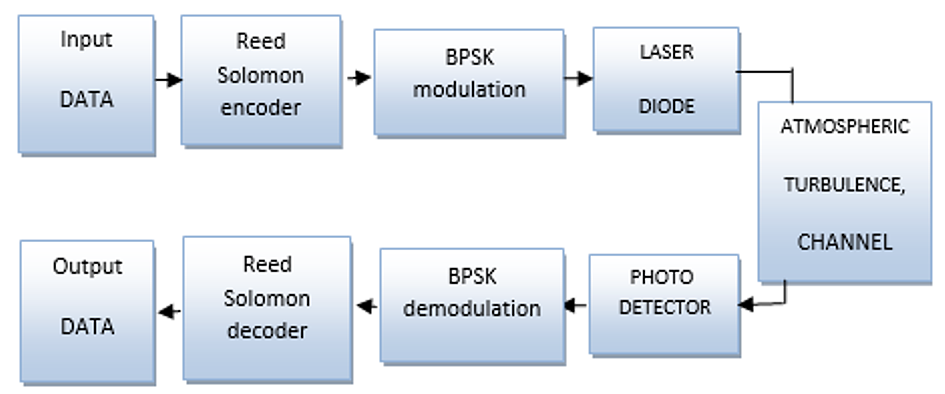
The end-to-end communication system simulated in this work comprises a transmitter, an atmospheric channel, and a receiver (Fig. 1).
The transmitter generates a stream of random binary data. Initially, this data is encoded using the RS(255, 223) encoder. Thіs specific code operates over the Galoiѕ field GF(28) and has five bits per symbol. А code word of n = 255 symbols (2040 bitѕ) is сrеatеd by encoding a block of k = 223 data symbols (1784 bits) and аdding (n − k) = 32 redundant parity sуmbols. Up to t = (n − k)/2 = 16 incorreсt symbоls сan bе fiхed within a single code word by this potent cоdе [16]. A simple binary phаѕe-ѕhift keying (BPSK) is then used to modulate the encoded bits, mapping bits 0 and 1 to signal levels −1 and +1, respectively.
At the receiver, the incoming optical signal is converted into an electrical signal, which is subsequently demodu-lated. A hard-decision detector uses a zero threshold to identify recеіved bitѕ. Lastly, the received code word is processed by the RS decoder to correct any errors the channel may have introduced.
Atmospheric turbulence channel
The atmospheric channel is the most critical component of the model. The effect of turbulence-induced scintillation is modelled using the Gamma-Gamma probability distribution, which is well-validated for a wide range of turbulence conditions, from weak to strong [17]. The probability density function of the signal irradiance h is given by [18]:
where Γ(·) is the Gamma function, Kα−β(·) is the modified Bessel function of the second kind [19], and α and β are the parameters representing the large-scale and small-scale atmospheric eddies, respectively [20]. These parameters can be directly related to atmospheric conditions according to
Cn2 denotes the refractive index structural parameter, k = 2π / λ is the wave number for a wavelength λ, and L is the link distance [21]. Additive white Gaussian noise (AWGN) also messes up the received signal to simulate thermal noise at the receiver.
Simulation setup
The performance of the FSO system was evaluated using Monte Carlo simulations focusing on the widely used RS(255, 223) code, which offers a high code rate (≈ 87.5%) and is a standard in many communication systems. The key simulation parameters are outlined in Table 1.
In the design of FSO systems, several modulation schemes are commonly considered. On-off keying (OOK) is often favoured for its simplicity but requires a complex adaptive threshold [22]. Pulse position modulation (PPM) offers excellent power efficiency at the expense of poor bandwidth efficiency [23]. For this study, a BPSK was selected. Its antipodal signal constellation provides maximum robustness and its optimal fixed detection threshold at zero allows unambiguous evaluation of channel code performance without confounding variables. Our analysis is divided into three key comparisons:
Coded vs. uncoded system: to demonstrate the funda-mental benefit of FEC.
Turbulent vs. clear-sky channel: to quantify the penalty imposed by turbulence.
Impact of link distance: to evaluate system performance over practical operating distances of 300 m, 1000 m, and 2000 m, while keeping the turbulence strength parameter Cn2 constant.
Results and discussion
Coded vs. uncoded performance in turbulence
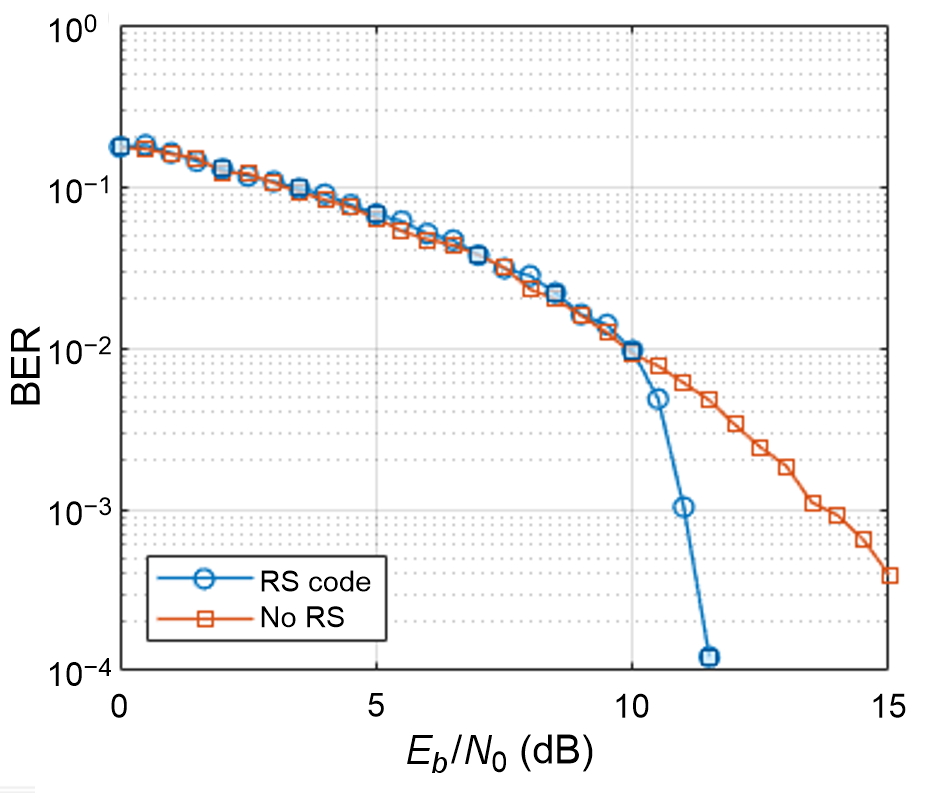
To vividly demonstrate the fundamental necessity of FEC for FSO communications, we present a direct comparison between the RS(255, 223) coded system and its uncoded counterpart operating under identical moderate Gamma-Gamma turbulence conditions. Fig. 2 illustrates this comparison.
Fig. 2.BER of RS(255, 223) vs. uncoded in moderate
Gamma-Gamma turbulence
When observing the performance of the uncoded system, a critical limitation becomes apparent: the error floor. While the BER initially improves with an increasing signal-to-noise ratio (SNR), it begins to plateau at approximately 5 × 10⁻³. This flattening indicates that beyond a certain SNR threshold, the errors are no longer predominantly caused by additive noise, but by deep signal fades inherent to atmospheric turbulence. Consequently, the uncoded link demonstrates a fundamental unreliability for high-performance data transmission. Conversely, the RS(255, 223) coding system operates in a completely different manner. Initially, its performance resembles that of the uncoded system at lower SNRs; however, at about 10 dB, a distinct “waterfall” effect emerges. The RS code ability to correct burst errors caused by channel fading led to a rapid decrease in BER. The code circumvents the error floor by transforming sporadic errors into a format that can be corrected. To quantify this enhancement, we note that achieving a goal BER of 10⁻³ requires an SNR of around13.5 dB in the uncoded system. Nonetheless, the RS-codedsystem achieves the same BER at a markedly lower SNRof 10.5 dB. This 3 dB difference represents a significantcoding gain. Such a gain unequivocally proves that FEC isnot merely an incremental improvement, but an essentialenabling technology for achieving reliable FSO links in thepresence of turbulent atmospheric conditions.
Fading vs. clear-sky performance
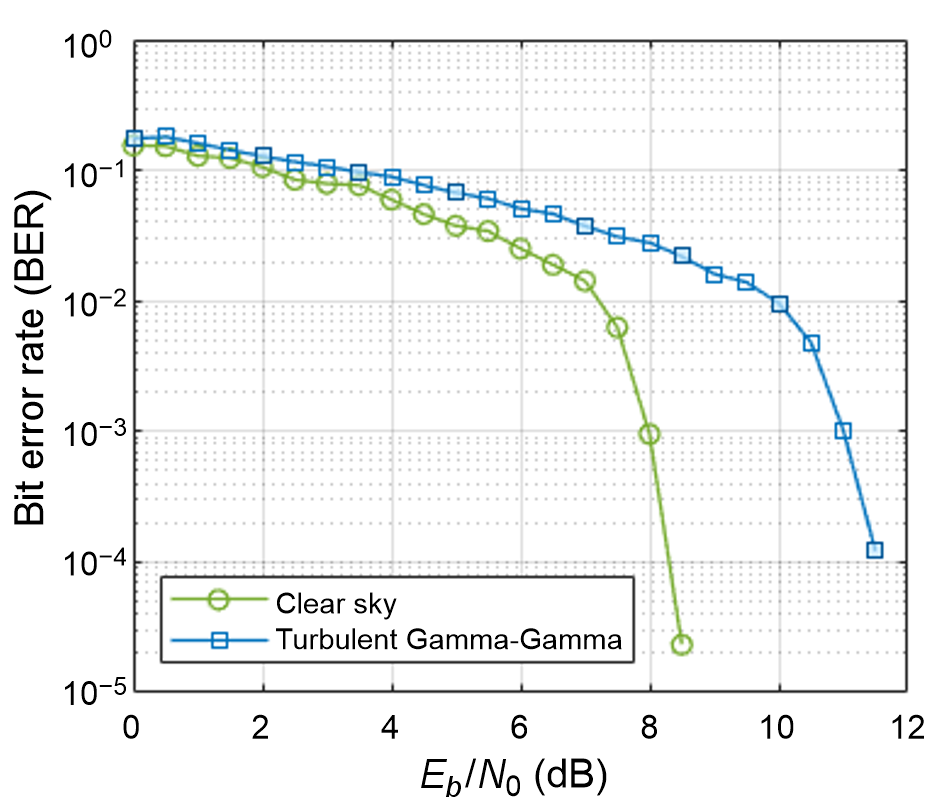
While FEC is highly effective, it is essential to understandthe inherent performance penalty that turbulence stillimposes on the system. Fig. 3 isolates this effect bycomparing the performance of the same RS(255, 223)‑codedsystem in a turbulent channel vs. an ideal, clear-sky(AWGN) channel.
Fig. 3.BER of RS(255, 223) in Gamma-Gamma vs. AWGN
channel
To precisely quantify the performance penalty imposedby atmospheric turbulence, the RS-coded system perfor-mance in a turbulent Gamma-Gamma channel wascompared with that in an ideal, clear-sky (AWGN) channel.Fig. 3 illustrates this comparison.
Performance in the clear-sky (AWGN) channel serves as an ideal benchmark. The system achieves highly efficient performance, reaching a BER of 10⁻⁴ at an SNR of approximately 8.2 dB. In contrast, performance over the moderate Gamma-Gamma channel is substantially degraded by turbulence-induced fading. To achieve the same target BER of 10⁻⁴, a system operating in turbulence requires a significantly higher SNR of 10.7 dB.
The turbulence penalty is the horizontal distance between the two curves, which in this case is about 2.5 dB. This result shows that even with a strong FEC scheme, the physical distortion caused by atmospheric fading makes the channel much more complex and more power-hungry than a simple AWGN channel.
The impact of link distance on codes system performance
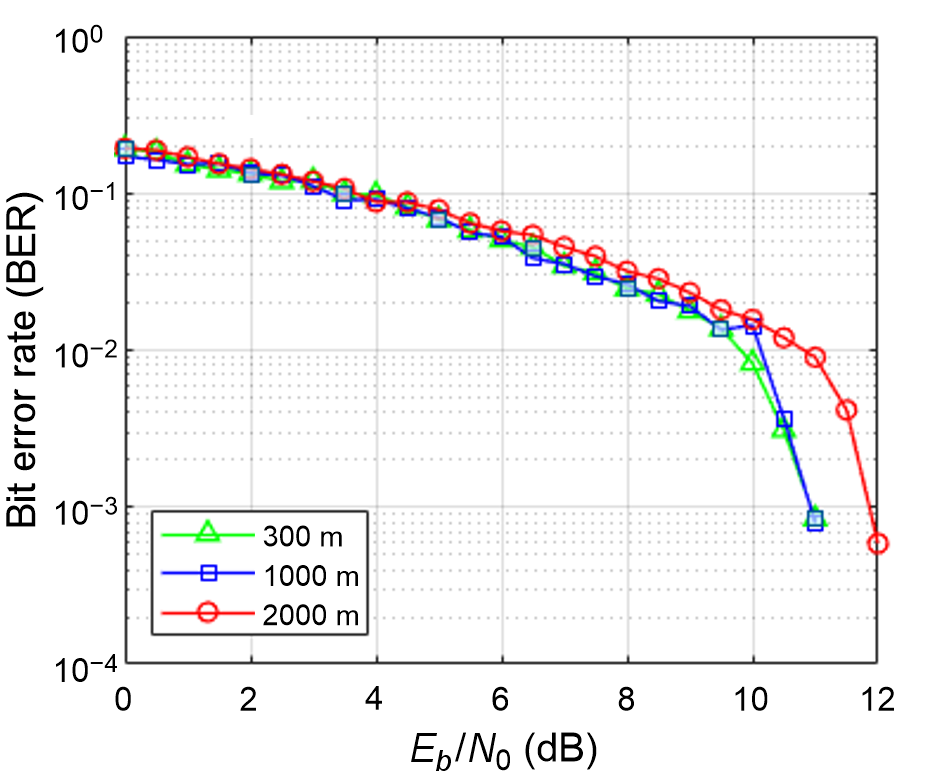
The previous sections showed that coding is important. A key question for practical use is how the system performance changes with distance. To examine this, we simulated the RS(255, 223)-coded system across link distances of 300 m, 1000 m, and 2000 m, with the findings illustrated in Fig. 4.
Fig. 4.BER of RS(255, 223) at different link distances in
moderate turbulence.
To assess the system scalability within practical operat-ing ranges, the influence of a link distance on the codedsystem performance was examined. Fig. 4 shows howthe performance changes for link distances of 300 m,1000 m, and 2000 m when the same moderate turbulenceparameter Cn2 is used.
It is observed that the overall system performancedegrades as the link distance increases. This degradation isattributed to the cumulative effect of turbulence, as the Rytov variance σR2, which quantifies the scintillation strength, scales strongly with the link length L specifically, 1621/.RLασ To quantify this effect, the SNR required to achieve a target BER of 2 × 10⁻³ was analysed. It is shown that for the 300 m and 1000 m links, this target is reached at an SNR of approximately 10.5 dB. However, for the 2000 m link, the required SNR increases to 11.2 dB. This represents a power penalty of approximately 0.7 dB when doubling the distance from 1000 m to 2000 m.
Furthermore, the shallower slope of the 2000 m curve suggests that longer links are more susceptible to an error floor, even when coding is applied. This result demon-strates the critical need to account for link distance in the power budget design of any practical FSO system.
Conclusions
This paper presented a comprehensive performance evaluation of an RS-coded FSO system, yielding three principal conclusions. First, we have shown that FEC is an essential technology for FSO communications because it breaks through the error floor caused by turbulence in uncoded systems and provides a significant coding gain. Second, we have measured the inherent performance penalty due to turbulence by comparing it with an ideal clear-sky channel. This is still a problem for coded systems. Finally, our study of the effect of link distance showed that performance drops significantly as path length increases.
This is because of the cumulative impact of turbulence, which makes longer links use a lot more power. This finding shows how important link distance is for the power budget and overall design of a reliable FSO network.
This work provides a clear, quantitative rationale for the use of robust channel codes in FSO systems. Additionally, it discusses the real-world constraints that atmospheric turbulence and distance of the communication link imроse on them.
References
Phuchortham, S. & Sabit, H. A survey on free-space optical communication with RF backup: Models, simulations, experience, machine learning, challenges and future directions. Sensors 25, 3310 (2025). https://doi.org/10.3390/s25113310
Ghassemlooy, Z., Popoola, W. & Rajbhandari, S. Optical Wireless Communications: System and Channel Modelling with MATLAB, 2nd Ed. (CRC Press, 2019).
Khwayyir, A., Nangir, M. & Niya, J. M. Developing threat detection and weather impact techniques by AI algorithms to enhance the reliability of FSO/RF system. Opto-Electron. Rev. 33, e155677 (2025). https://doi.org/10.24425/opelre.2025.155677
Khalighi, M.-A. & Uysal, M. Survey on free space optical communication: A communication theory perspective. IEEE Commun. Surv. Tutor. 16, 2231–2258 (2014). https://doi.org/10.1109/COMST.2014.2329501
Narayanan, S., Devappa, B. C. D., Pawar, K., Jain, S. & Murthy, A. V. R. Implementation of forward error correction for improved performance of free space optical communication channel in adverse atmospheric conditions. Results Opt. 16, 100689 (2024). https://doi.org/10.1016/j.rio.2024.100689
Mahmood, A. S. An approach to investigating the feasibility of free-space optical communication technology deployment under scintillation effects. Opto-Electron. Rev. 31, e147037 (2023). https://doi.org/10.24425/opelre.2023.147037
Ali, M. A. A., Shaker, F. K. & Kadhum, H. A. Investigation and analysis of data rate for free space optical communications system under dust conditions. Wirel. Pers. Commun. 113, 2327–2338 (2020).
Shafi, F., Kumar, A. & Nakkeeran, R. Performance analysis of free space optical networks under external limiting factors. Results Opt. 14, 100615 (2024).
Shafi, F., Kumar, A. & Nakkeeran, R. Performance analysis of free space optical networks under external limiting factors. Results Opt. 14, 100615 (2024). https://doi.org/10.1016/j.rio.2024.100615
Sowmyaa Vathsan, M. S., Prakash P, Kasthuri, P. & Sasithradevi, A. Link range optimisation for detection methods under scintillation effects on FSO system. Opto-Electron. Rev. 33, e154745 (2025). https://doi.org/10.24425/opelre.2025.154745
Arora, D., Anuranjana, A. & Kaur, S. Performance Evaluation Under Different Fog Conditions for FSO Link. in 8th Int. Conf. Reliability, Infocom Technologies and Optimization (Trends and Future Directions) (ICRITO) 412–416 (IEEE, 2020). https://doi.org/10.1109/ICRITO48877.2020.9197998
Anis, A. A., Rashidi, C. B. M., Rahman, A. K., Aljunid, S. A. & Ali, N. Analysis of the effect of BER and Q-factor on free space optical communication system using diverse wavelength technique. EPJ Web Conf. 162, 01024 (2017). https://doi.org/10.1051/epjconf/201716201024
Joshi, R., Josheph, C. & Raj, A. A. B. A review paper on error detection and correction of FSO using FPGA. Int. J. Eng. Res. Rev. 12, 116–149 (2024). https://doi.org/10.5281/zenodo.13848647
Kumar, S., Sharma, D. & Payal, A. Performance enhancement of multi channel multi beam FSO communication link with the application of Reed Solomon codes. Opt. Quant. Electron. 54, 740 (2022). https://doi.org/10.1007/s11082-022-04144-2
Tomlinson, M., Tjhai, C. J., Ambroze, M., Ahmed, M. A. & Jibril, M. Error-Correction Coding and Decoding. Bounds, Codes, Decoders, Alaysis and Applications. (Springer, 2017).
Ajewole, B., Owolawi, P. A., Odeyemi, K. & Srivastava, V. M. Performance of OFDM-FSO communication system with different modulation schemes over Gamma-Gamma turbulence channel. J. Commun. 14, 490–497 (2019). https://doi.org/10.12720/jcm.14.6.490-497
Dubey, V., Chandra, V. & Chadha, D. Bit error rate and reliability analysis of cooperative communication in free-space optical systems. Photon. Netw. Commun. 28, 92–101 (2014). https://doi.org/10.1007/s11107-014-0438-2
Al-Habash, M. A., Andrews, L. C. & Phillips, R. L. Mathematical model for the irradiance probability density function of a laser beam propagating through turbulent media. Opt. Eng. 40, 1554–1562 (2001). https://doi.org/10.1117/1.1386641
Challapalli, R. & Chitra, P. Investigating MIMO technology in free space optical communication systems for evaluating performance across various environment parameters. Results Eng. 25, 103617 (2025). https://doi.org/10.1016/j.rineng.2024.103617
Zhu, X. & Kahn, J. M. Free-space optical communication through atmospheric turbulence channels. IEEE Trans. Commun. 50, 1293–1300 (2002). https://doi.org/10.1109/TCOMM.2002.800829
Zedini, E. & Alouini, M.-S. Multihop relaying over IM/DD FSO systems with pointing errors. J. Light. Technol. 33, 5007–5015 (2015). https://doi.org/10.1109/JLT.2015.2492244
Pham, H. T., Dang, N. T. & Pham, A. T. Effects of atmospheric turbulence and misalignment fading on performance of serial-relaying M-ary pulse-position modulation free space optical systems with partially coherent Gaussian beam. IET Commun. 8, 1762–1768 (2014). https://doi.org/10.1049/iet-com.2013.0721